
.svg)

.svg)


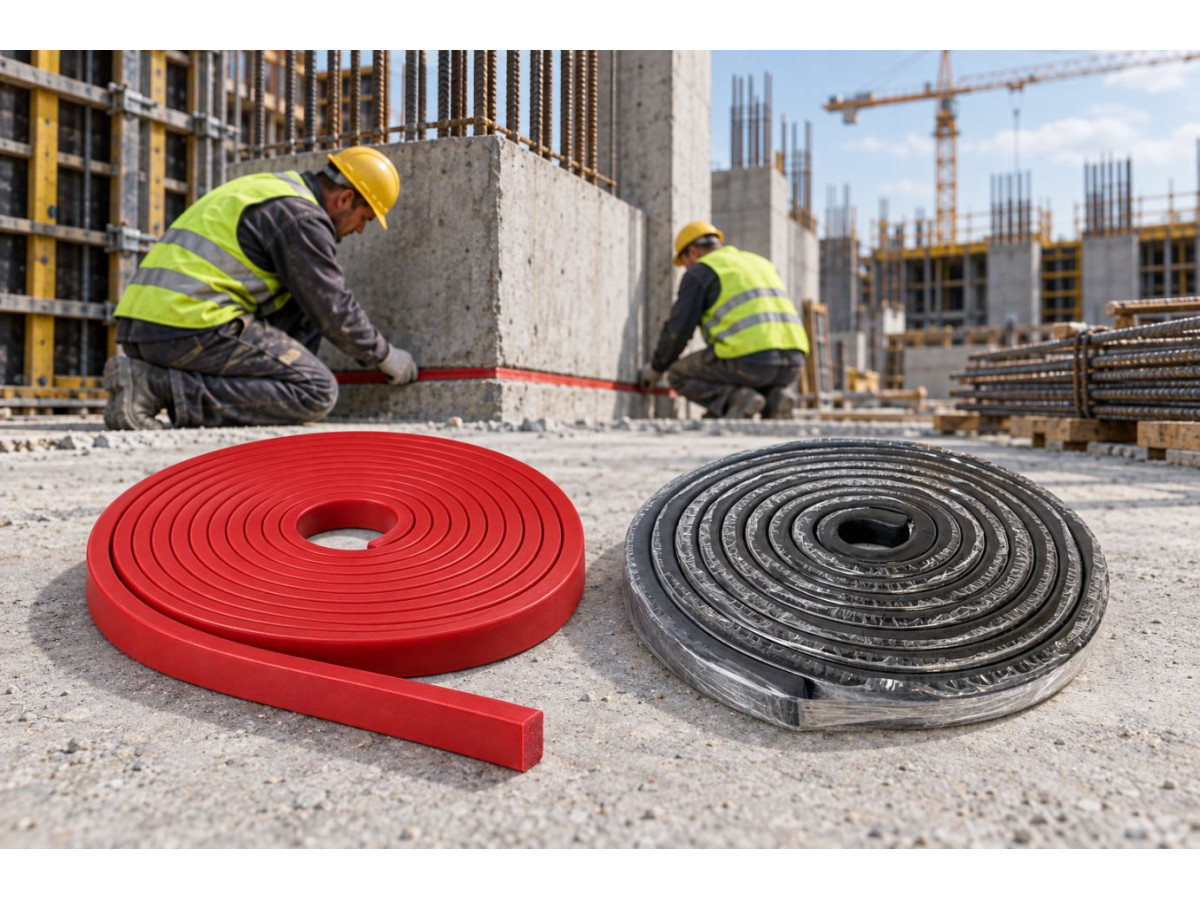
For sealing concrete construction joints, a swelling waterproofing cord is used. When in contact with water, the material increases in volume, fills cracks and voids, and forms a watertight barrier.
Let us consider the difference between two materials: SANSTORE bentonite cord and PRONIL acrylic hydrophilic cord.
The bentonite cord is manufactured based on natural bentonite and special fillers. The composition may also include crystalline additives and butyl rubber.
The cord seals the structure in two stages:
- Swells immediately after contact with water.
- Additionally seals pores and cracks due to the crystallization process.
The self-swelling effect allows the material to penetrate small cracks and voids in the concrete structure. After drying, the cord decreases in size, and upon repeated contact with water, it swells again.
Where the bentonite cord is used
- construction and cold concrete joints;
- joints of monolithic and precast reinforced concrete structures;
- connections between the foundation slab and wall;
- foundations, basements and underground structures;
- areas where engineering utilities pass through;
- cracks and voids in concrete structures.
The SANSTORE bentonite cord withstands water pressure of up to 7 bar. After seven days in water, its volume increases by at least 210%. The maximum relative expansion reaches 400% (or 4 times).
PRONIL Acrylic Hydrophilic Cord
The PRONIL acrylic swelling cord is made of hydrophilic polymer rubber with inorganic fillers and does not contain bentonite.
The material has a homogeneous structure, so it is not washed out during operation and does not lose its properties after repeated “swelling — drying” cycles. After seven days in water, the cord increases in volume by at least 300%. The maximum relative expansion reaches 650% (or 6.5 times).
Where the acrylic cord is used
- cold and construction concrete joints;
- foundation and basement wall joints;
- areas where pipes and engineering utilities pass through;
- swimming pools and water reservoirs;
- sewage systems;
- water treatment and hydraulic structures;
- structures that come into contact with salt water or chemicals.
The PRONIL hydrophilic cord also withstands water pressure of up to 7 bar, and is characterized by frost resistance, durability and resistance to washout.
Comparison of bentonite and acrylic cords
| Characteristic | SANSTORE | PRONIL |
|---|---|---|
| Base | Bentonite with special fillers | Acrylic hydrophilic rubber |
| Color | Black | Red |
| Volume increase after 7 days | At least 210% | At least 300% |
| Resistance to water pressure | Up to 7 bar | Up to 7 bar |
| Repeated swelling cycles | Swells in water and decreases after drying | Retains its properties after repeated cycles |
| Resistance to washout | Depends on composition and operating conditions | Homogeneous structure, resistant to washout |
| Salt water and chemicals | Operating conditions must be taken into account | Increased resistance |
| Main advantage | Cost-effectiveness and the combined effect of swelling and crystallization | Stability, durability and a higher degree of expansion |
Which waterproofing cord to choose
SANSTORE bentonite cord is advisable for standard waterproofing of foundations, basements, joints and concrete construction joints. It is an economical solution with good swelling performance and an additional crystallization effect.
PRONIL acrylic cord is recommended for critical structures, structures exposed to repeated wetting and drying cycles, as well as where contact with salt water or a chemically active environment is possible.
The bentonite cord is fixed to a clean concrete surface with dowels at approximately 25–30 cm intervals or using adhesive sealant. Under high lateral pressure, galvanized expanded metal mesh is used for additional fixation.
Both types of cord must be protected from premature wetting before the concrete is poured. They are designed for sealing construction and working joints, but are not used instead of special profiles in expansion joints.
At Sanstore, you can purchase SANSTORE bentonite cord and PRONIL acrylic swelling cord. We will help you compare the characteristics and select the material according to the conditions of your project.
Write a comment