
.svg)

.svg)


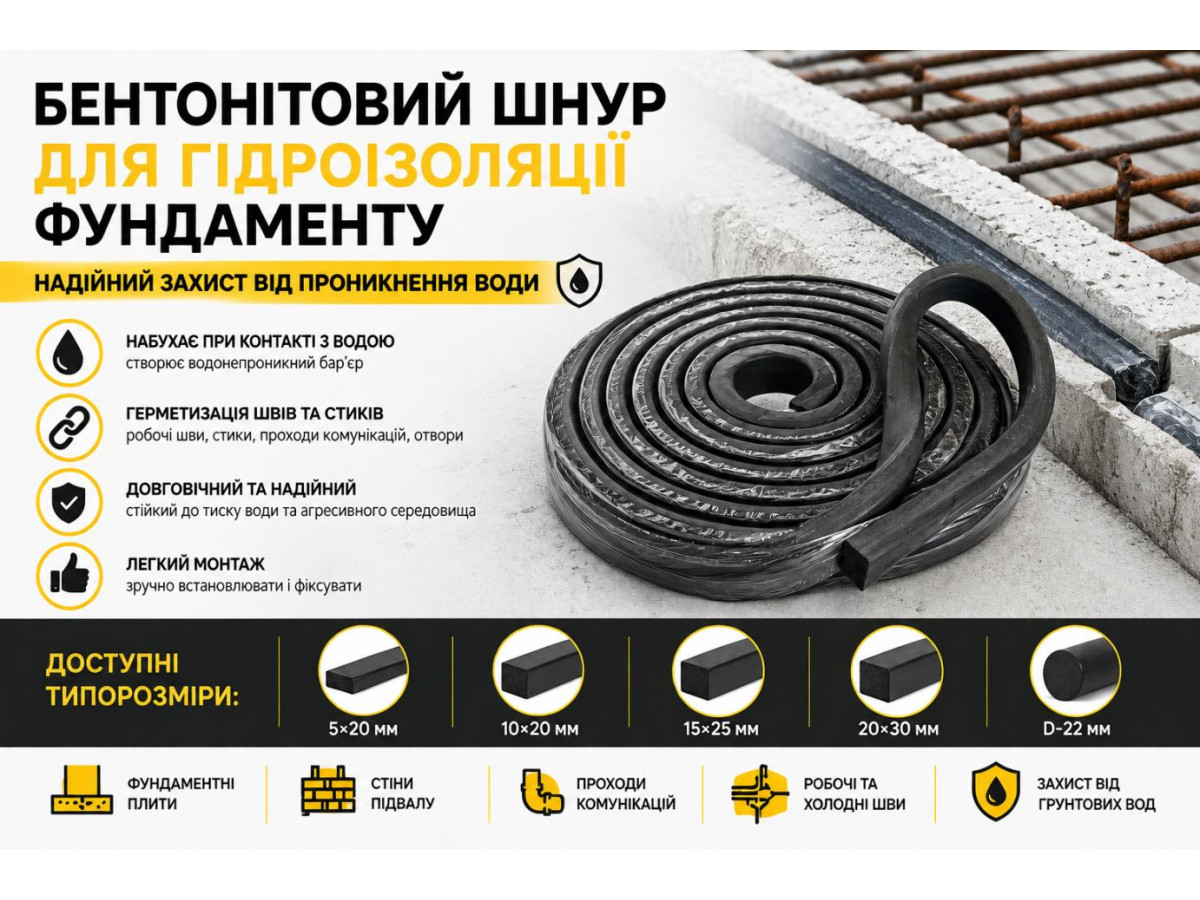
Foundation waterproofing is an essential condition for building durability. Even solid concrete structures can seep water through construction and cold joints, component connections, or utility penetrations.
To seal such areas, a bentonite waterstop tape is used. Upon contact with water, it swells and seals the surrounding space, creating an additional barrier against moisture ingress.
Where Bentonite Waterstop Is Used in Foundations
Bentonite waterstops are applied for local sealing of the most vulnerable areas in concrete structures.
Main applications include:
construction and cold joints in concreting;
junctions between foundation slabs and walls;
basement wall connections to the foundation slab;
joints in concrete and reinforced concrete structures;
pipe and utility penetrations;
tie-rod and formwork holes after shuttering removal;
underground parts of buildings in contact with groundwater.
Thus, a bentonite waterstop is not intended for continuous surface waterproofing of the foundation; rather, it protects joints, seams, and specific structural nodes where water could otherwise penetrate.
Bentonite Waterstop for Foundation Slabs
This material is particularly relevant during phased concreting of a foundation slab.
A construction joint forms between the existing hardened concrete and the newly poured concrete. If left unsealed, it can become a pathway for water to enter the underground structure.
The bentonite waterstop tape is laid along the intended joint line and secured before the next concrete pour. Upon contact with water, it swells and seals the joint area.
The waterstop is also applied at the connection line between the foundation slab and vertical walls, where construction joints frequently occur.
Important: a bentonite waterstop acts as a key element of a waterproofing system and does not replace comprehensive foundation protection.
How to Choose the Size of a Bentonite Waterstop
Choosing the correct cross-section depends on the structure type, joint dimensions, concrete thickness, and operating conditions.
SANSTORE offers rectangular profiles as well as the round D-22 waterstop.
|
Size |
Shape |
Application |
5×20 mm |
rectangular |
Pipe and utility penetrations |
10×20 mm |
rectangular |
Construction and cold joints in concreting |
15×25 mm |
rectangular |
Joints in foundations and concrete structures |
20×30 mm |
rectangular |
Massive foundation slabs and underground structures |
D-22 mm |
round |
Formwork tie-rod holes after shuttering removal |
Bentonite Waterstop 5×20 mm
A compact rectangular profile designed for convenient sealing around pipe penetrations and utility inlets.
Bentonite Waterstop 10×20 mm
One of the standard sizes for sealing construction and cold joints in concrete structures.
Bentonite Waterstop 15×25 mm
Used for waterproofing joints in foundations, foundation slabs, and other concrete or reinforced concrete elements.
Bentonite Waterstop 20×30 mm
A larger profile suitable for heavy-duty concrete structures, foundation slabs, and critical underground installations.
Round Bentonite Waterstop D-22
Features a distinct application profile compared to rectangular strips. It is used to seal formwork tie-rod holes and process openings.
Bentonite Waterstops for Basement Waterproofing
During basement construction, bentonite waterstops are placed in areas where concreting is performed in stages:
at the slab-to-wall junction;
in horizontal and vertical construction joints;
around utility penetrations;
in formwork tie-rod holes.
To ensure effective protection of underground spaces against groundwater, the waterstop should be integrated alongside other waterproofing system components.
Sealing Pipe Penetrations in Foundations
Another key application area involves utility penetrations passing through the foundation wall.
The perimeter around a pipe can act as a water path even if the concrete itself remains crack-free. For these nodes, an appropriately sized bentonite strip, such as 5×20 mm, should be specified.
For detailed guidance on this installation, read our full article "Sealing Pipe and Utility Penetrations with Bentonite Waterstops."
What to Consider Before Purchasing
Before selecting a bentonite waterstop, evaluate the following factors:
type of concrete structure;
location of the joint or junction;
thickness of the concrete section;
operating conditions and potential water exposure;
required waterstop cross-section.
A larger profile is not always better. Dimensions must match the specific structural detail and engineering project requirements.
If you are unsure which bentonite waterstop fits your foundation best, provide our specialist with details regarding structure type, concrete thickness, joint location, and exposure conditions – this will help us select the optimal size.
Conclusion
Bentonite waterstops for foundation waterproofing are applied to protect construction and cold joints, slab-to-wall connections, utility penetrations, and tie-rod holes.
Different tasks require specific cross-sections: ranging from the compact 5×20 mm to the heavy-duty 20×30 mm profile, while the round D-22 mm profile serves dedicated hole-sealing applications.
A properly selected and installed bentonite waterstop enhances the watertightness of concrete structures and keeps underground spaces reliably protected from water ingress.
Write a comment